Since the hydroxyl group is a poor leaving group, it is first converted into a group that can depart as a weak base.
These processes begin by reaction of alcohol oxygen as a base or nucleophile, after which the modified oxygen group undergoes substitution.
Commonly used reagents:
- Hydrogen Halides (Halogen Acids) ()
- Phosphorus Pentahalide ()
- Phosphorus Trihalide ()
- Thionyl Halide ()
Halogen Acids

| /Alcohol | 1 | 2 | 3 |
|---|---|---|---|
| X | |||
| X | X | X | |
| ^The-table-refers-to-the-need-of-use-of-catalysts |
- (Order of reactivity for Alcohols) 3 > 2 > 1 < 0
- (Order of reactivity for Hydrogen Halides) > > ( is generally unreactive.)
Alcohols react with strong acidic hydrogen halides but they do not react with non acidic sodium halides. Primary and Secondary alcohols can be converted into alkyl chlorides and alkyl bromides by allowing them to react with a mixture of a sodium halide and sulfuric acid.

- and are generally generated by and respectively.
Although halide ions are strong nucleophiles, they are not strong enough to carry out substitution reactions with alcohols themselves, as then the leaving group would have to be a strongly basic hydroxide ion.
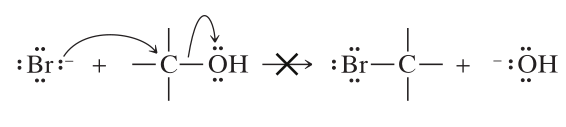
Non-primary alcohols.
They appear to react by a mechanism that involves the formation of a carbocation. The mechanism is similar to that of dehydration. (Rearrangements are expected c:)
→ (Steps 1 and 2) (Same as dehydration.)
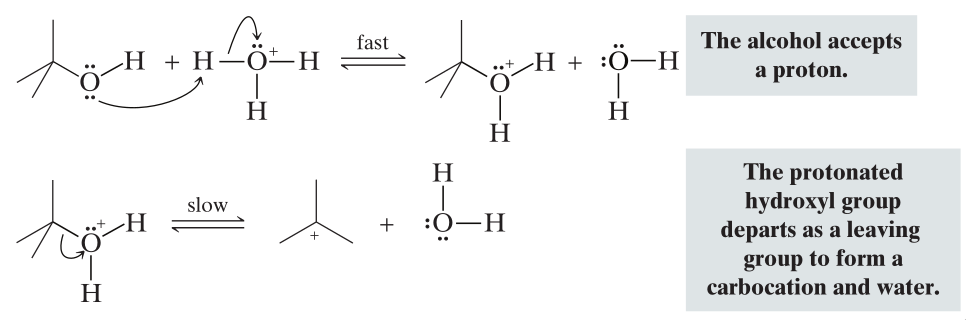
- The hydroxyl group is protonated by a hydronium ion.
- The protonated hydroxyl group (), being a good leaving group, departs to form a carbocation and water.
→ (Step 3)

- Here the point of difference comes in between dehydration of alcohol and formation of an alkyl halide from an alcohol.
- Dehydration of Alcohol: It is done at high temperatures and in presence of concentrated . After the protonation of the hydroxyl group, is formed, which is a bad nucleophile. At high temperatures the highly reactive carbocation forms a more stable product in the form of alkene, which being volatile, distills from the reaction mixture as its being formed, causing the reaction equilibrium to shift towards alkene formation → Resultant mechanism is . In some instances the carbocation also reacts with or sulfuric acid itself. Here they form alkyl hydrogen sulfates ()
- Conversion of Alcohols to Alkyl Halides: It is done in presence of acid and halide ions, not at elevated temperatures. Halide ions are good nucleophiles and since they usually are present in high concentrations, most of the carbocations react with an electron pair of a halide ion to form a more stable species, the alkyl halide → Resultant mechanism is . These two reactions, being very similar, due to the common carbocation intermediate, sometimes compete and therefore very often during the conversions of alcohols to alkyl halides, the reaction is accompanied by the formation of some alkene.
Primary Alcohols
Primary alcohols and methanol react to form alkyl halides under acidic conditions by following a reaction.
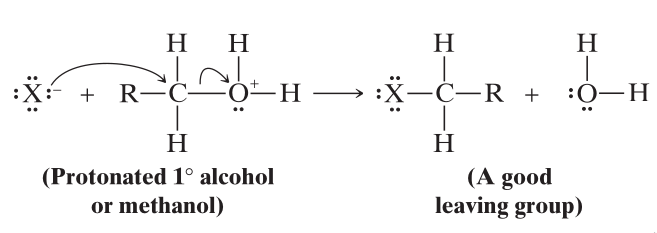 → (Step 1)
- The first step is the protonation of the hydroxyl group. → (Step 2)
- The halide ion displaces the leaving group.
Phosphorus Pentahalide, Phosphorus Trihalide and Thionyl Halide
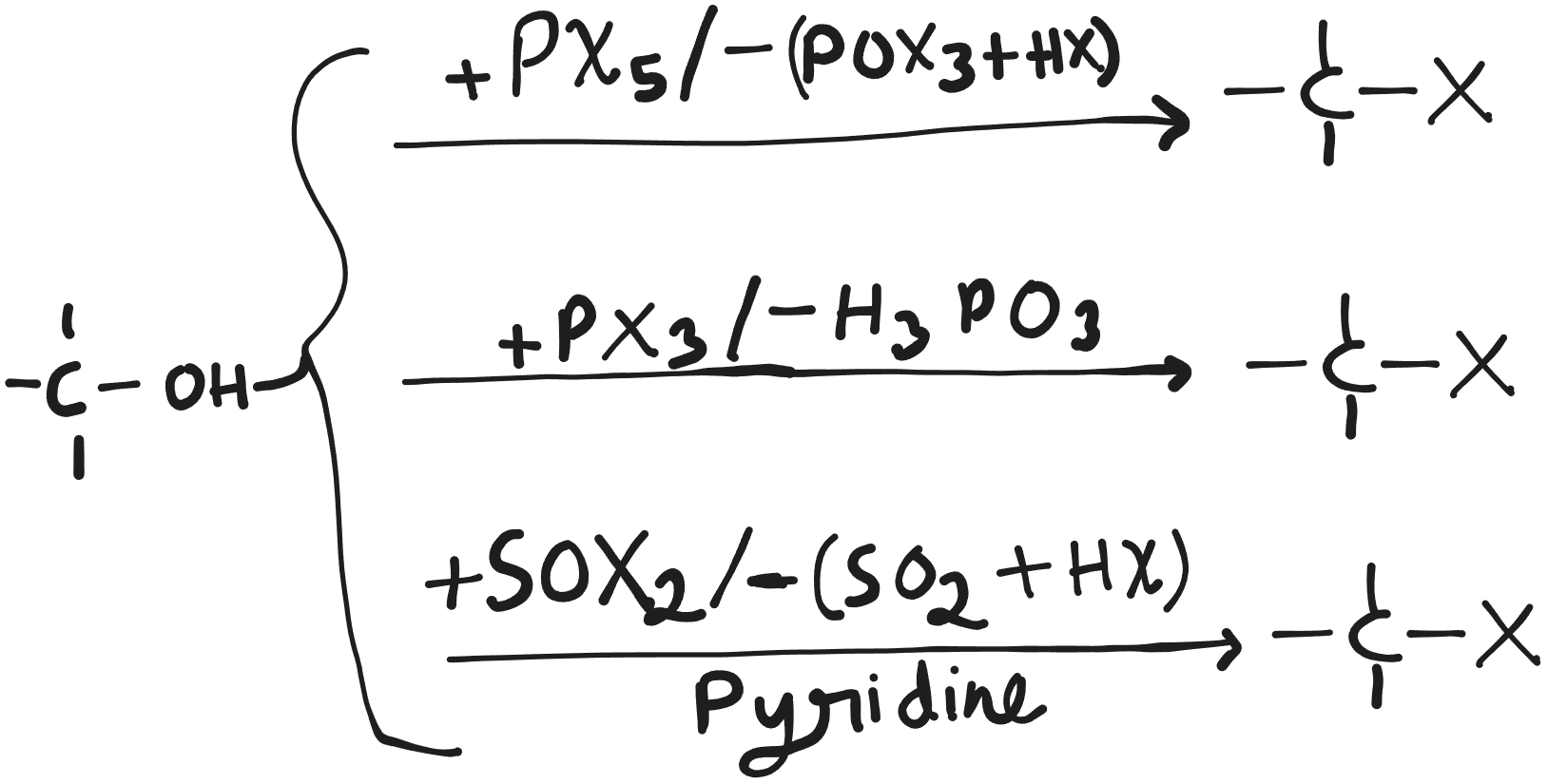
- These reactions do not involve the formation of a carbocation and usually occurs without rearrangement.
- They are preferred when transforming an alcohol into its corresponding alkyl bromide.
| Yes | Yes | |
| Yes | ||
| No | ||
| ^the-table-refers-to-allowed-use-of-halides |
- For , can either be or .
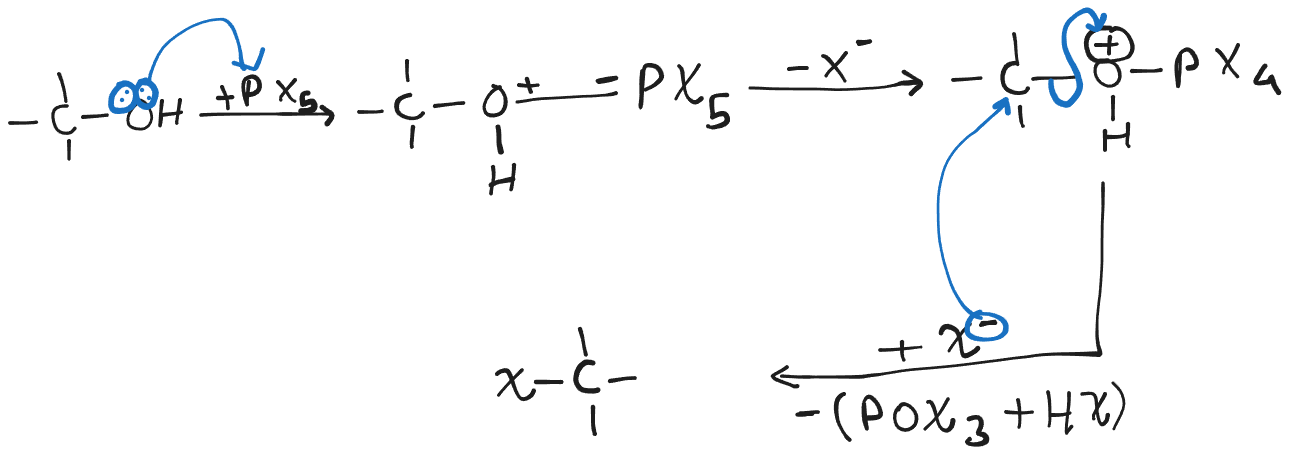
- type of reaction.
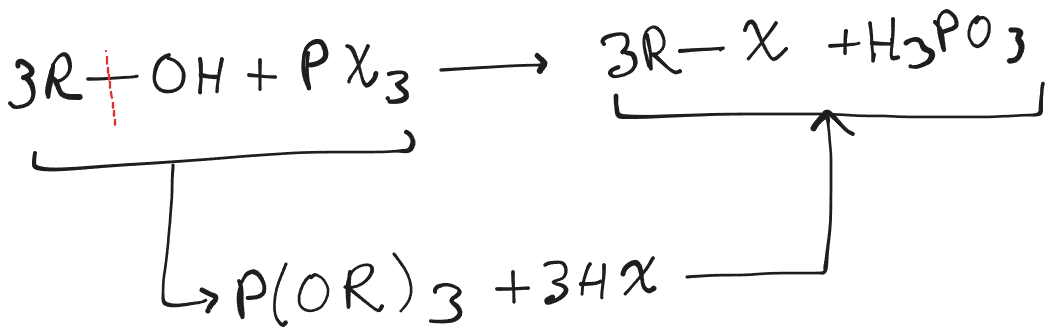
- “Controversial” ⇒ Thought of as
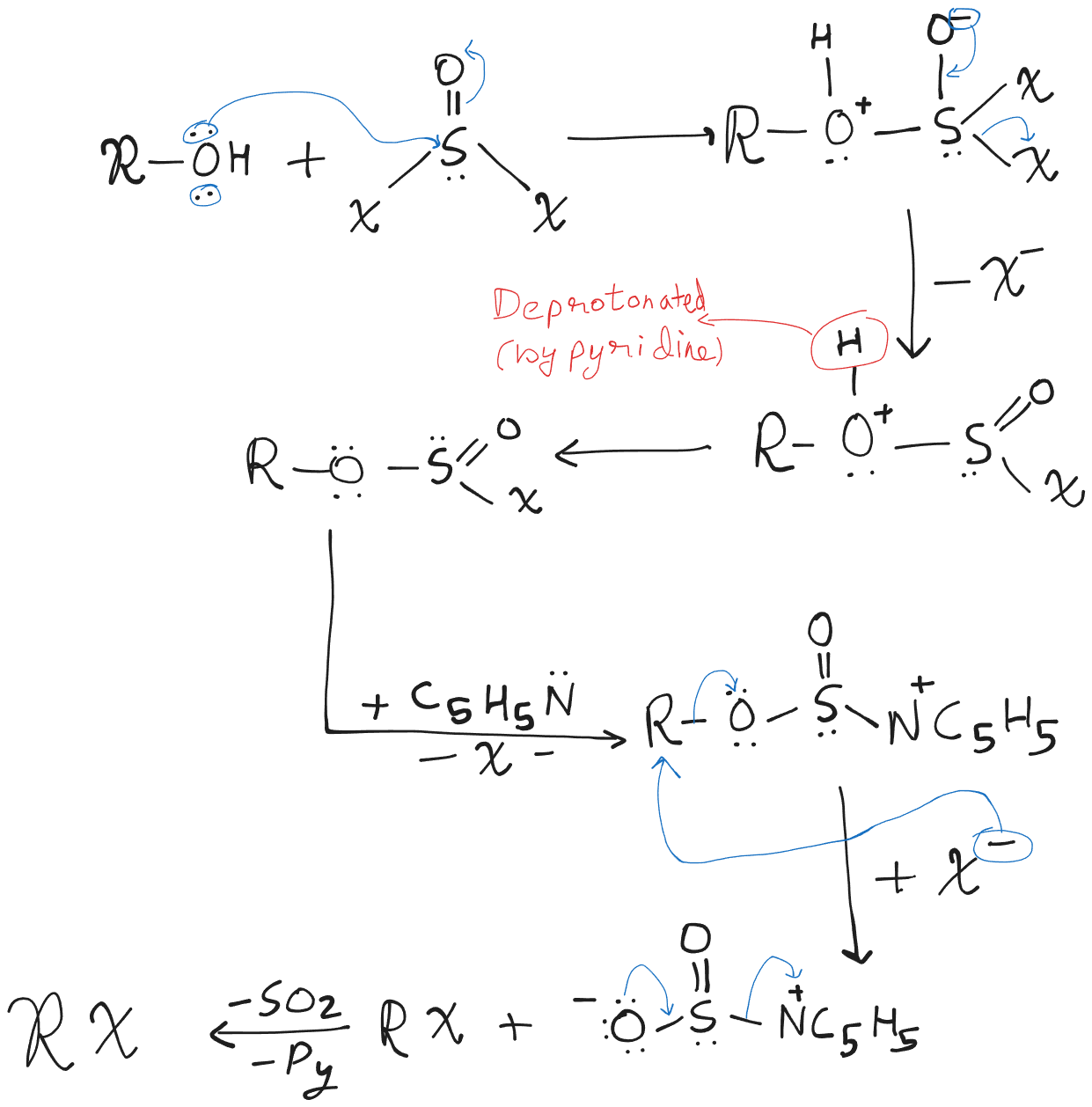
- Pyridine is often used to promote the reaction. The initial reaction is the formation of alkylhalosulfite which then reacts rapidly with pyridine to give a prydinium alkylsulfite intermediate. This intermediate is attacked by the halide ion which displaces the sulfite leaving group, which decomposes later. ⇒ Mechanism followed is .